Monday, July 12, 2010

Psalms 103

I am comforted by David’s adoration in the 103rd Psalm.

Bless the LORD, O my soul: and all that is within me, bless his holy name. [Psalms 103:1 KJV]

This is not the blessed/happiness of the Beatitudes, this is the worshipful, kneeling praise of adoration to God. David tells us here what God has done for him, why God is to be worshipped.

Bless the LORD, O my soul, and forget not all his benefits: [Psalms 103:2 KJV]

Praise and adore Him not because of future expectations, but what He has proven in the past.

Who forgiveth all thine iniquities; who healeth all thy diseases; [Psalms 103:3 KJV]

Right at the top of the list is forgiveness. The reason that is so important is that mankind must accept that there is a need for forgiveness to begin with. David was thankful for God’s forgiveness because he received it when he confessed his sins. He understood, and stated in his confession, that his sin was against God.

And David said unto Nathan, I have sinned against the LORD. [2 Samuel 12:13a KJV]

David then thanked God for redemption.

Who redeemeth thy life from destruction; who crowneth thee with lovingkindness and tender mercies; [Psalms 103:4 KJV]

Again, as David himself had experienced.

And Nathan said unto David, The LORD also hath put away thy sin; thou shalt not die. [2 Samuel 12:13b KJV]

David continued in praise and adoration of all God has done, to Israel as a people and to David as an individual.

Who satisfieth thy mouth with good things; so that thy youth is renewed like the eagle's.
The LORD executeth righteousness and judgment for all that are oppressed.
He made known his ways unto Moses, his acts unto the children of Israel.
The LORD is merciful and gracious, slow to anger, and plenteous in mercy.
He will not always chide: neither will he keep his anger for ever.
He hath not dealt with us after our sins; nor rewarded us according to our iniquities.
For as the heaven is high above the earth, so great is his mercy toward them that fear him.
As far as the east is from the west, so far hath he removed our transgressions from us.
Like as a father pitieth his children, so the LORD pitieth them that fear him.
For he knoweth our frame; he remembereth that we are dust.
As for man, his days are as grass: as a flower of the field, so he flourisheth.
For the wind passeth over it, and it is gone; and the place thereof shall know it no more.
But the mercy of the LORD is from everlasting to everlasting upon them that fear him, and his righteousness unto children's children; To such as keep his covenant, and to those that remember his commandments to do them.
The LORD hath prepared his throne in the heavens; and his kingdom ruleth over all.
Bless the LORD, ye his angels, that excel in strength, that do his commandments, hearkening unto the voice of his word.
Bless ye the LORD, all ye his hosts; ye ministers of his, that do his pleasure.
Bless the LORD, all his works in all places of his dominion: bless the LORD, O my soul.
[Psalms 103:5-22 KJV]

Sunday, July 11, 2010

Your Ministry?

About once a year, or a month or so longer, our internet connectivity takes a vacation. No notice at all, and I turn on my Need-to-Know-Right-Now mode and start learning all I forgot from last year, and the new stuff my PC/ISP/Router providers have added that I don’t know -- yet. Last year it was in May. This year (so far) we’ve only lost a couple of days last month. I think we have it returned to the standard available 24/7 that we’ve come to expect.

Of course, it made me think of how our time spent in God’s service is measured. Do you ever notice empty spots in pews?

Some people think if they attend church on special holidays, that’s quite enough for each year. Others decide being there Sunday mornings starts their week off right and they don’t need to come back until next week.

Others take a seat in their pew for every service. Actually looking askance should some new person be sitting in their regular place.

Then there are those who regularly are not in their pews. We have a lot of those. Sometimes they’ll miss Sunday morning worship services and show up Sunday night. Their pew is empty every Wednesday night during school, but you’ll find them there in the summer when classes change and fewer children attend. You’ll find their car in the parking lot on Thursdays and some Saturdays, but not on a Sunday, when they drive a van picking up children.

Who are these people? Ministers, but not preachers. Church workers, but not the hired staff. Ministers because they have chosen to follow our Lord and provide service and training to His family.

They include a number of ladies who miss services to take care of babies and toddlers in the nursery; those who come during the week for visitation, sometimes going in pairs, sometimes alone; the youth and children workers who arrive early on Wednesdays when school meets, spending two hours training and playing with children from pre-K through 6th grade. Then there are ushers, who spend as much time in the back as in their pews as sitting in them. Or bus drivers who are keeping an eye on their passengers-without-parents, driving before and after services.

That doesn’t start to mention the Sunday School teachers. Each and every week they spend hours planning lessons, sending messages to their students and presenting Bible lessons. Or the youth leaders, shoulders drenched with the teen-years tears. Or the librarian who places orders, checks them in, prepares them for checking out then follows up with those of us who are forgetful about returning on time. (I do think I’d better check my bookcase!!)

Why? Because He first loved us, we’ve come to love Him and want to share our family with others.

Where are the scriptures for today? They are displayed In the lives of those who serve in the ministry of their choice.

Every church member should have one. If one of my readers does not, you are missing out on rewards here – and there. Pray for God’s will to be evident, then go serve. We’ll notice, but much more importantly, He’ll notice.


(This photo was taken by a neighbor, not a member, of our church after a fall storm and was kind enough to share with us)

Saturday, July 10, 2010

At Least Three Times

On a recent Sunday morning our pastor’s message was building God’s church through personal evangelism. We had a visiting preacher Sunday night – he spoke on the same message. Neither man had mentioned to the other the subject they were using.

I’ve found that often God sends the same message to us. Maybe just to get our attention. That same Sunday I posted
Be Still, Patiently. I needed that message. It came to me twice Sunday morning – Psalms 46:10 was used in the lesson in Sunday School, and it was the scripture chosen to be placed in our bulletin. I received His message three times.

Long ago I learned that quite often His message is placed in front of me three times. There was a specific situation in our family. My mother-in-law told me, in no uncertain terms, that it would be up to me to make the first move. Feeling the aggrieved party, I pushed the information aside. The following Saturday, my mother told me the same thing. I know the topic was not discussed between them. And I knew that neither one called our pastor – yet his Sunday morning sermon was on forgiveness, seventy times seven!

John 21:15-17 has Jesus asking Peter three times, “Lovest thou me?” while He knew the answer in advance.

It takes repetition to get an important message across – especially to someone who has preconceived notions and a somewhat impetuous personality. I mean Peter, of course!

There have been numerous writings about our Lord, beginning that first century. Not unusual, as John saw it.

And there are also many other things which Jesus did, the which, if they should be written every one, I suppose that even the world itself could not contain the books that should be written. Amen. [John 21:25 KJV]

Everyone who met Him, who heard Him, could write a book about that experience. But I really like the preceding verse, which limits what should be written.

This is the disciple which testifieth of these things, and wrote these things: and we know that his testimony is true. [John 21:24 KJV]

We are not told that Luke met Jesus, yet I love the books of Luke and Acts, for they read as though written by a researcher, a detail-oriented author who checks facts. We do not know if Theophilus was the name of a living person or if Luke was writing to all of us who love God. Either way, the resulting documentation of living for God is a blessing to all who read it.

Paul’s letters to the churches have oft repeated phrases, too. Though he writes to each one for a specific purpose, admonishing and encouraging always returns to Christ as the example for us to follow and God’s love for mankind that provided salvation.

But God, who is rich in mercy, for his great love wherewith he loved us, Even when we were dead in sins, hath quickened us together with Christ, (by grace ye are saved;) [Ephesians 2:4-5 KJV]

That theme is repeated more than three times, throughout the books of the New Testament.

For God so loved the world, that he gave his only begotten Son, that whosoever believeth in him should not perish, but have everlasting life. [John 3:16 KJV]

We love him, because he first loved us. [1 John 4:19 KJV]

Friday, July 9, 2010

Matthew 5

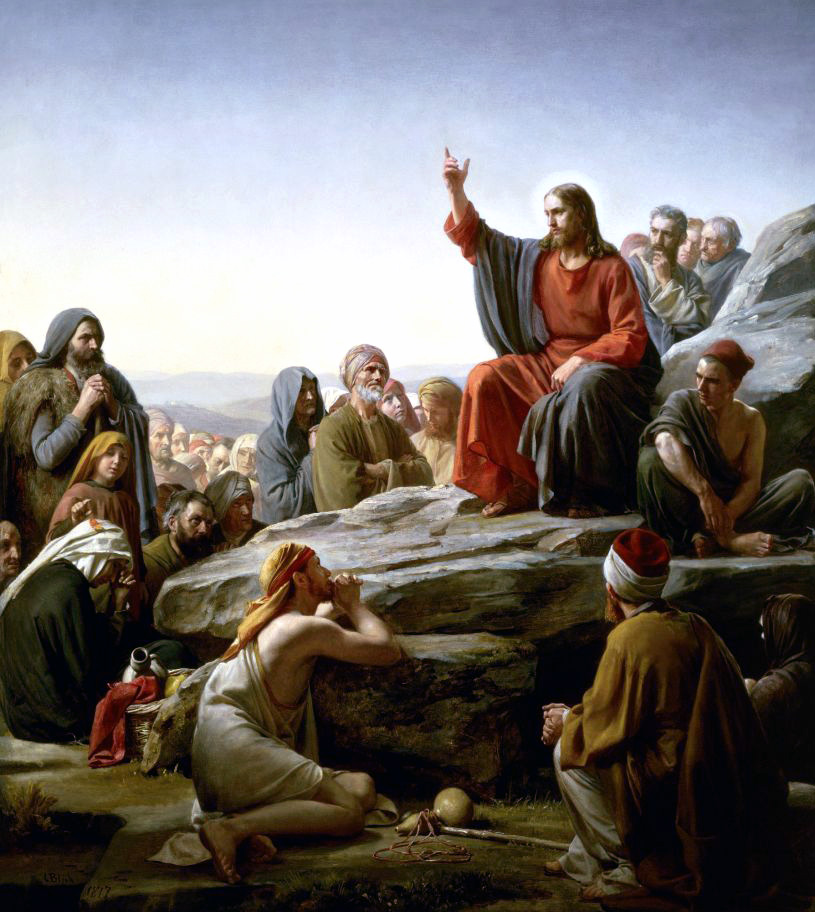
And seeing the multitudes, he went up into a mountain: and when he was set, his disciples came unto him: And he opened his mouth, and taught them, saying, [Matthew 5:1-2 KJV]

What follows in Jesus’ sermon on this mountain are some of the most basic truths of Christianity. Children are taught at a very early age the “Be Attitudes”, Matthew 5:3-13, which tell us how to be happy in our lives. Then we’re told that we are as salt, a city, a candle – essential things, if used correctly, but useless if not. We’re then told about the everlasting commandments of God.

Then begins an interesting segment of contrasts – Ye have heard versus But I say unto you.

Ye have heard that it was said by them of old time, Thou shalt not kill; and whosoever shall kill shall be in danger of the judgment: [Matthew 5:21 KJV]

Christ begins to discuss traditions versus reality. Most of the world has heard of the Ten Commandments and are familiar with Thou shalt not kill. In nations then and today there were rules about this, listing punishments for murder.

But I say unto you, That whosoever is angry with his brother without a cause shall be in danger of the judgment: and whosoever shall say to his brother, Raca, shall be in danger of the council: but whosoever shall say, Thou fool, shall be in danger of hell fire. [Matthew 5:22 KJV]

The words of God have deeper meaning than the superficial glances we give them.

Ye have heard that it was said by them of old time, Thou shalt not commit adultery: [Matthew 5:27 KJV]

Good advice. Great harm comes from breaking one’s marriage vows. Families are torn asunder and lives are impacted in succeeding generations. But it is done so very quickly without thought. I’m thinking of two celebrities this year whose infidelities not only have made national headlines in mainstream media, but have cost them millions of dollars in their divorces. They are but a couple among millions. Yet, Christ tells us there is much more than a physical infidelity.

But I say unto you, That whosoever looketh on a woman to lust after her hath committed adultery with her already in his heart. [Matthew 5:28 KJV]

Again, ye have heard that it hath been said by them of old time, Thou shalt not forswear thyself, but shalt perform unto the Lord thine oaths: [Matthew 5:33 KJV]

This one is so simple to understand. How can we swear to accomplish anything when our lives depend on so many variables outside our control? Christ not only confirms this, but gives examples of why our answers should be ‘Yes’ or ‘No.’

But I say unto you, Swear not at all; neither by heaven; for it is God's throne: Nor by the earth; for it is his footstool: neither by Jerusalem; for it is the city of the great King. Neither shalt thou swear by thy head, because thou canst not make one hair white or black. But let your communication be, Yea, yea; Nay, nay: for whatsoever is more than these cometh of evil. [Matthew 5:34-37 KJV]

There is more. Much more, but I’ve reached my self-imposed size limitation. Take a bit of time and continue in this sermon. Truly, the words of God have meaning in our lives today.

Thursday, July 8, 2010

Laboring in Vain

There have always been doctrinal differences among people who worship within the same religion. There are enough differences between the Sunni and Shi’a versions of Islam to start wars in our own time. The same held true of Christians divided between nations of Catholics and protestants. Jews in the first century were divided, too. Pharisees believed in a resurrection. Sadducees did not. I remember the difference by thinking, they were sad, you see.

Christ answered the question of resurrection Himself.

But as touching the resurrection of the dead, have ye not read that which was spoken unto you by God, saying, I am the God of Abraham, and the God of Isaac, and the God of Jacob? God is not the God of the dead, but of the living. [Matthew 22:31-32 KJV]

There were doctrinal differences within the New Testament church. Paul sought to clarify one of those differences.

Now if Christ be preached that he rose from the dead, how say some among you that there is no resurrection of the dead? [1 Corinthians 15:12 KJV]

This is the very basis of Christianity. Without it, Jesus of Nazareth was a philosopher at the very least, and perhaps a prophet as some see Him. With it, He is the Son of God.

As a philosopher, His teachings are acceptable to a majority of the world’s population. They see Him caring for everyone and encouraging all to do so, too. If He was no more than a prophet, His prophecies fall short, not having been fulfilled.

Those who look upon Him solely as a philosopher or prophet learn of Him from the New Testament, selecting only what is acceptable, rejecting that which does not apply to their view. Many read of Him and reject Him based on the lives of others, judging by man’s hypocrisy instead of God’s plan.

Our desires to do as we please, not as God planned, has been the basis of disobedience since Eve looked upon the tree and saw that the tree was good for food, and that it was pleasant to the eyes, and a tree to be desired to make one wise, she took of the fruit thereof, and did eat, and gave also unto her husband with her; and he did eat. [Genesis 3:6]

It is much easier to reject Him than to accept Him. Acceptance means researching, learning, listening, discerning, determining which version is true and serves God, or which is a false lead serving only another man’s ego. Acceptance means service, ministering to others in His name, giving God the credit, the acclaim, the glory, pointing to Him as the source of all things good.

Paul put it openly and bluntly.

For if the dead rise not, then is not Christ raised: And if Christ be not raised, your faith is vain; ye are yet in your sins. [1 Corinthians 15:16-17 KJV]

Examples follow to display this truth, and he closes the thought confirming our labor is not in vain.

But thanks be to God, which giveth us the victory through our Lord Jesus Christ. Therefore, my beloved brethren, be ye stedfast, unmoveable, always abounding in the work of the Lord, forasmuch as ye know that your labour is not in vain in the Lord. [1 Corinthians 15:57-58 KJV]
(The 'Lone Fish' photo was taken by my niece who graciously granted permission for its use here.
Please do not copy without requesting permission.)

Wednesday, July 7, 2010

Day Trip

We went to Dublin yesterday. No, not a quick trip to the emerald isle. It’s a town of close to 5,000 whose biggest claim to fame is Dr. Pepper.

The soft drink wasn’t invented there (that was Waco, Texas), but the oldest Dr. Pepper plant is there. Built in 1891, it still produces what Texans know as Dublin Dr. Pepper, and it is different from all other plants. Here, instead of the high fructose corn syrup sweetener used by other soft drinks, they still use Imperial pure cane sugar. Other plants haven’t since sugar cane from Cuba became unobtainable.

For most north Texans (and lots of other people), Dr. Pepper is the soft drink of choice. Among those, Dublin offers the best of the best. We missed their annual birthday celebration in June, when the town is officially known as Dr. Pepper, Texas.

I like their website’s closure:

“Bill Kloster was a man of conviction. When small bottlers have been gobbled up by conglomerates, the tiny, independent Dublin Dr Pepper plant remains. Its signature product is produced just like it was more than 100 years ago. Bill wasn’t afraid of bucking marketing trends because he believed in the unique quality of his product.”

In some ways it describes the two-dozen people who went from our church to the plant. We are an independent, fundamental Baptist congregation. Our daily lives differ from those first-century Christians in secular ways, but we continue to meet on the Lord’s day to hear preaching (though usually not as long as Paul’s.)

And upon the first day of the week, when the disciples came together to break bread, Paul preached unto them, ready to depart on the morrow; and continued his speech until midnight. [Acts 20:7 KJV]

We bring our tithes and offerings for His work, just as they were instructed to do.

Upon the first day of the week let every one of you lay by him in store, as God hath prospered him, that there be no gatherings when I come. [1 Corinthians 16:2 KJV]

When someone comes to the understanding of a central truth:

For all have sinned, and come short of the glory of God; [Romans 3:23 KJV]

And they’ve made public their profession of faith in our Lord as savior:

For with the heart man believeth unto righteousness; and with the mouth confession is made unto salvation. [Romans 10:10 KJV]

They come for baptism:

Therefore we are buried with him by baptism into death: that like as Christ was raised up from the dead by the glory of the Father, even so we also should walk in newness of life. [Romans 6:4 KJV]

And, they worship the Lord, our God.

Jesus said unto him, Thou shalt love the Lord thy God with all thy heart, and with all thy soul, and with all thy mind. This is the first and great commandment. And the second is like unto it, Thou shalt love thy neighbour as thyself. On these two commandments hang all the law and the prophets. [Matthew 22:37-40 KJV]

Tuesday, July 6, 2010

Yahweh Is My Strength

There are so many kings in Israel’s history that we tend to overlook them, skipping from Solomon to the prophets, with just a few lessons in between. We are neglecting excellent lessons by doing so. I was reminded of this recently with an introduction to Uzziah, one of David’s descendants listed in Matthew’s genealogy of Jesus.

His name means ‘Yahweh is my strength.’ We are introduced to him at age sixteen.

Sixteen years old was Uzziah when he began to reign, and he reigned fifty and two years in Jerusalem. His mother's name also was Jecoliah of Jerusalem. And he did that which was right in the sight of the LORD, according to all that his father Amaziah did. And he sought God in the days of Zechariah, who had understanding in the visions of God: and as long as he sought the LORD, God made him to prosper. [2 Chronicles 26:3-5 KJV]

A great start, isn’t it? He listened to others, selecting those who could achieve what was needed.

Also he built towers in the desert, and digged many wells: for he had much cattle, both in the low country, and in the plains: husbandmen also, and vine dressers in the mountains, and in Carmel: for he loved husbandry. [2 Chronicles 26:10 KJV]

Strong. Powerful. Capable. All attributes of a great leader.

And he made in Jerusalem engines, invented by cunning men, to be on the towers and upon the bulwarks, to shoot arrows and great stones withal. And his name spread far abroad; for he was marvellously helped, till he was strong. [2 Chronicles 26:15 KJV]

Lord Acton’s dictum comes into play right after this. “Power tends to corrupt, and absolute power corrupts absolutely.”

But when he was strong, his heart was lifted up to his destruction: for he transgressed against the LORD his God, and went into the temple of the LORD to burn incense upon the altar of incense. [2 Chronicles 26:16 KJV]

As Saul did before him, Uzziah made the mistake Lucifer stated aloud.

I will ascend above the heights of the clouds; I will be like the most High. [Isaiah 14:14 KJV]

Authority is granted by God, not taken from Him.

Let every soul be subject unto the higher powers. For there is no power but of God: the powers that be are ordained of God. [Romans 13:1 KJV]

Uzziah did not have the authority given to the priests to burn incense upon the altar. Usurping that authority cost him his health and his kingdom.

And Uzziah the king was a leper unto the day of his death, and dwelt in a several house, being a leper; for he was cut off from the house of the LORD: and Jotham his son was over the king's house, judging the people of the land. [2 Chronicles 26:21 KJV]

He forgot that
as long as he sought the LORD, God made him to prosper. [2 Chronicles 26:5 KJV]

Detail of Uzziah from Michelangelo Buonarroti's Sistine Chapel, Vatican (1511)