Thursday, February 3, 2011

NOT, Again

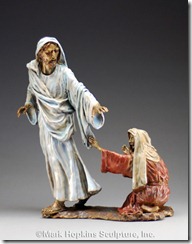
Touched_copyright_Mark_Hopkins

(Big THANKS to Mark Hopkins for this single-instance use of “Touched”. Please take time to visit his gallery)

Thinking about yesterday's post, there are quite a few other things Jesus did NOT do here while He taught His disciples.

He did NOT heal everyone. We're told He healed many and there were specific instances given. We are not told that he declined to heal any that came to Him, but there was no wholesale healing for a specified area around Him. We know one woman was healed simply by touching His garment, and He was aware of that touch.

And Jesus, immediately knowing in himself that virtue had gone out of him, turned him about in the press, and said, Who touched my clothes? [Mark 5:30 KJV]

His disciples thought He had lost His mind.

And his disciples said unto him, Thou seest the multitude thronging thee, and sayest thou, Who touched me? [Mark 5:31 KJV]

They didn't understand Him any more than we do, and they walked with Him hour by hour.

Jesus did NOT set up an earthly kingdom. Oh, the Jews were expecting that then and still are today. The salvation they sought was from Rome, not from their sins. They wanted a bigger piece of this world, not of the spiritual one He offered . We're no different. We continue to lay up treasures here on earth -- and losing them to natural or man-made disasters. Pilate asked about His kingdom.

Jesus answered, My kingdom is not of this world: if my kingdom were of this world, then would my servants fight, that I should not be delivered to the Jews: but now is my kingdom not from hence. [John 18:36 KJV]

Jesus did NOT force people to follow Him. When He sent the seventy, they had their instructions as to what to say and to heal, but they were also instructed how to deal with those who did not accept, too.

But into whatsoever city ye enter, and they receive you not, go your ways out into the streets of the same, and say, Even the very dust of your city, which cleaveth on us, we do wipe off against you: notwithstanding be ye sure of this, that the kingdom of God is come nigh unto you. But I say unto you, that it shall be more tolerable in that day for Sodom, than for that city. [Luke 10:10-12 KJV]

Jesus did NOT ignore sin. Even thoughtless sin from those about Him.

But he turned, and said unto Peter, Get thee behind me, Satan: thou art an offence unto me: for thou savourest not the things that be of God, but those that be of men. [Matthew 16:23 KJV]

Peter took the admonition to heart. Many church members, on the other hand, become angry, even leave their church, when a sermon approaches any condemnation of their lifestyle choices. We fail to understand that the world was condemned before He was born. He explained to Nicodemus:

For God sent not his Son into the world to condemn the world; but that the world through him might be saved. [John 3:17 KJV]

However, there is another side to that coin. Without His salvation, the condemnation remains.

He that believeth on him is not condemned: but he that believeth not is condemned already, because he hath not believed in the name of the only begotten Son of God. [John 3:18 KJV]

I recently commented on how many people can quote John 3:16 and speak of God's love for this world, yet they do not read the next two verses and come to the light of the world.

Too many of us do NOT.

Wednesday, February 2, 2011

What He Didn’t Do

SermonOnTheMount-Bloch

History is made up of things that happened. Sometimes fiction is written about a differing outcome, but in school we concentrate on dates, people and events. We make up rhymes to help us remember.

Some are not quite sufficient. For example, we learned: Columbus sailed the ocean blue in 1492. Then someone taught us: Columbus sailed the deep blue sea in 1493. Mustn’t forget: Columbus set sail once more in 1494! Confusing.

Christians talk, write, read and teach about what Christ did while He was here on earth. Most of our Bibles have a Harmony of the Gospels to show what occurred chronologically. It is good to do such studies, to check what was done, with whom, what was said and why.

However, we also need to take a look at what Jesus did NOT do. He did not bring people into the Temple to worship God. Oh, he was in the Temple often, speaking, reading and usually making its leaders angry. But He didn’t spend most of His time in Jerusalem. He spent it walking across Judea speaking to the people. And, He didn’t confine those visits to Jews.

Another thing He did NOT do was set up a priestly system with overseers. Many denominations have done an excellent job of that, but Christ did not. Instead He sent His followers out to speak to others, just as He had done. His instructions were simply to tell people that the kingdom of God was nigh (Luke 10).

He did NOT build a great university, gathering professors to expound on the greatness of God or His creation. He taught one-on-one, as with Nicodemus; He taught in small groups, as with the twelve. He taught multitudes on hillsides. He had no campuses, no professors, no debates.

That doesn’t mean any of these things are bad, just that they were not necessary for His purpose. His purpose is not ours, either. We are to witness to others regarding His life, but His purpose was to glorify His father and to die for the sins of the world. We are not called to do so. We are called to be a part of the body of Christ working in this world to do his bidding. We have different gifts to accomplish our tasks, too.

Having then gifts differing according to the grace that is given to us, whether prophecy, let us prophesy according to the proportion of faith; Or ministry, let us wait on our ministering: or he that teacheth, on teaching; Or he that exhorteth, on exhortation: he that giveth, let him do it with simplicity; he that ruleth, with diligence; he that sheweth mercy, with cheerfulness. (Romans 12:6-8 KJV)

Within that body, we have specific tasks, all designed to work toward perfection:

And he gave some, apostles; and some, prophets; and some, evangelists; and some, pastors and teachers; For the perfecting of the saints, for the work of the ministry, for the edifying of the body of Christ: (Ephesians 4:11-12 KJV)

We must take care that it’s not our ‘perfection’, but Christ’s we use as our goal.

For the perfecting of the saints, for the work of the ministry, for the edifying of the body of Christ: Till we all come in the unity of the faith, and of the knowledge of the Son of God, unto a perfect man, unto the measure of the stature of the fulness of Christ: (Ephesians 4:12-13 KJV)

We do this to grow!

That we henceforth be no more children, tossed to and fro, and carried about with every wind of doctrine, by the sleight of men, and cunning craftiness, whereby they lie in wait to deceive; (Ephesians 4:14 KJV)

Tuesday, February 1, 2011

Snow!!!


Well, we're under the white part. Appears that we'll come out from under the snow shortly, maybe without receiving much more. When I let the dogs out this morning, the snow was packed up against the doggie door -- and that's on the south side of the house! Well, sort of southwest, but the bulk of the house should have protected their run slightly.

I wondered how many times snow was mentioned in the Bible and found twenty-four verses. Most references were descriptive:

His countenance was like lightning, and his raiment white as snow: [Matthew 28:3 KJV]

Or:

I beheld till the thrones were cast down, and the Ancient of days did sit, whose garment was white as snow, and the hair of his head like the pure wool: his throne was like the fiery flame, and his wheels as burning fire. [Daniel 7:9 KJV]

Which is so similar to:

And in the midst of the seven candlesticks one like unto the Son of man, clothed with a garment down to the foot, and girt about the paps with a golden girdle. His head and his hairs were white like wool, as white as snow; and his eyes were as a flame of fire; [Revelation 1:13-14 KJV]

More often being white as snow refers to leprosy, as in the first reference, where God is preparing Moses to confront pharoah. God tells him why, then creates miracles upon command:

That they may believe that the LORD God of their fathers, the God of Abraham, the God of Isaac, and the God of Jacob, hath appeared unto thee. And the LORD said furthermore unto him, Put now thine hand into thy bosom. And he put his hand into his bosom: and when he took it out, behold, his hand was leprous as snow. And he said, Put thine hand into thy bosom again. And he put his hand into his bosom again; and plucked it out of his bosom, and, behold, it was turned again as his other flesh. [Exodus 4:5-7 KJV]

I was also reminded:

For he saith to the snow, Be thou on the earth; [Job 37:6 KJV]

Each reference speaks of His abilities that are so far above ours, yet He cares for us. Simply awesome.

So, we continue to await spring. I know many of you are affected by the storm and I pray for your safety.

Monday, January 31, 2011

Stepping Out

For my thoughts are not your thoughts, neither are your ways my ways, saith the LORD. For as the heavens are higher than the earth, so are my ways higher than your ways, and my thoughts than your thoughts. [Isaiah 55:8-9 KJV]

Isn’t that the truth?!?! And I’m grateful for that. I’m reminded of it when I read about Christ’s life.

And in the fourth watch of the night Jesus went unto them, walking on the sea. [Matthew 14:25 KJV]

See what I mean? How many of us even think about walking across water, much less do so? We think it can’t be done, just as Christ’s disciples.


And when the disciples saw him walking on the sea, they were troubled, saying, It is a spirit; and they cried out for fear. [Matthew 14:26 KJV]

Just as the disciples, we cry out in fear when we realize that Christ can do things we cannot, therefore we do not understand and we back away. Peter didn’t, though. Impetuous as usual, when Christ identified himself, Peter wanted to join Him.


But straightway Jesus spake unto them, saying, Be of good cheer; it is I; be not afraid. And Peter answered him and said, Lord, if it be thou, bid me come unto thee on the water. And he said, Come. And when Peter was come down out of the ship, he walked on the water, to go to Jesus. [Matthew 14:27-29 KJV]

You know He calls us, still. One of my favorites is where Peter tells us that in 2 Peter 3:9. He wrote from his own experience. Jesus called him to be a fisher of men and he responded. He called to Jesus to “bid me come unto thee.” Jesus responded, “Come,” and Peter did. He was walking on the water just as the Christ. For a few moments, then worldly things got in his mind.

But when he saw the wind boisterous, he was afraid; and beginning to sink, he cried, saying, Lord, save me. [Matthew 14:30 KJV]

Not that the wind affected him or caused him to fail, but his fear did. He had sufficient faith to step out onto the water and head for Jesus. He lacked the faith that Christ could uphold him in the boisterous wind.

And immediately Jesus stretched forth his hand, and caught him, and said unto him, O thou of little faith, wherefore didst thou doubt? [Matthew 14:31 KJV]

As Christians today, we react much the same. You’d think we’d learn over the centuries, but every once in a while those white clouds in the distance become dark and boisterous and we lean to our own understanding, even when we’ve been told not to:

Trust in the LORD with all thine heart; and lean not unto thine own understanding. [Proverbs 3:5 KJV]

Step out in faith. Even if it is not as we expect, for His thoughts are not ours, He is able to sustain.

Sunday, January 30, 2011

On With The New

Butterfly

Would you really want to crawl around chewing on leaves in a lumpy body with dozens of feet? How about if you knew that there would be a period of rest, then you could fly?

That’s such a beautiful picture of what Christians expect. No, we do not think it’s the same as the butterfly, but the analogy fits. We’re humans, tied to this earth, confined to work and eat and sleep and repeat. I wrote a children’s story about Billy’s Garden where Clarence Caterpillar did just that, then changed and learned to fly.

He did not change on his own. He changed according to God’s plan for his species. Now, let’s take a look at God’s plan for us.

God’s plan has stages for us, too: Without God; with God in us; with God. Too often that middle stage is missed and God is not to be found in us. There is no ‘fruit of the spirit’ (Galatians 5:22, Ephesians 5:9) to show how we love Him because He first loved us. (1 John 4:19) Once we’ve accepted Christ as our savior, the first change takes place and God is in us:

And I will pray the Father, and he shall give you another Comforter, that he may abide with you for ever; Even the Spirit of truth; whom the world cannot receive, because it seeth him not, neither knoweth him: but ye know him; for he dwelleth with you, and shall be in you. (John 14:16-17 KJV)

Then begins the change – the putting off of the old, and putting on the new:

That ye put off concerning the former conversation the old man, which is corrupt according to the deceitful lusts; And be renewed in the spirit of your mind; And that ye put on the new man, which after God is created in righteousness and true holiness. (Ephesians 4:22-24 KJV)

That doesn’t get us to the flying stage, though. Those changes just help us keep His commandment to love Him and others, and show that love in our actions. The real change comes in the transition from this life to our home.

Therefore we are always confident, knowing that, whilst we are at home in the body, we are absent from the Lord: (For we walk by faith, not by sight:) We are confident, I say, and willing rather to be absent from the body, and to be present with the Lord. (2 Corinthians 5:6-8 KJV)

Paul speaks of this last change:

In a moment, in the twinkling of an eye, at the last trump: for the trumpet shall sound, and the dead shall be raised incorruptible, and we shall be changed. For this corruptible must put on incorruption, and this mortal must put on immortality. (1 Corinthians 15:52-53 KJV)

So, I will not have the beautiful wings of a butterfly, but I will put on incorruptible immortality. He says so. I believe. Do you?

Saturday, January 29, 2011

Schedule!

Agenda

No, that’s not really my calendar. I keep mine on my iPhone so the changes are not as apparent. But this past week’s schedule might have appeared this way had it been on paper. So very much happened. The one day I wasn’t at a doctor’s office or hospital, I attended a funeral.

Two days were spent with First Daughter, one while they did a mylegram and and a scan at the hospital (she had minor complications and remains dizzy), the other was an EMG where they place electrodes and poke needles into nerves. Neither one much fun at all. The other medical trips were for a Good Friend’s pre-op and Beloved Husband’s therapy. Both are recovering. My own health seems to be fine, thank you very much for asking.

First Daughter, though, is not, and prayer for her upcoming surgery will be greatly appreciated, please! She’s paying a neurosurgeon to slit her throat. Don’t worry, it’s not only the same operation that gave me relief several years ago, it’s the same surgeon. Odd, it’s not really for the same reason, though.

I had a herniated disk between C3-C4 and congenital stenosis of the spinal. Hers is caused by the multiple rear-end accidents people have given her since she was eighteen. Most of them occurred when she was stopped at a stop sign or stopped by traffic in front of her. It’s almost as though there was a sign on the back of her car with a huge target.

What ever the causes, she will undergo surgery next Thursday morning and we truly covet your prayers for her speedy recovery.

When praying, please give thanks.

Giving thanks always for all things unto God and the Father in the name of our Lord Jesus Christ; (Ephesians 5:20 KJV)

Throughout the Bible, we are exhorted to give thanks.

Give thanks unto the LORD, call upon his name, make known his deeds among the people. (1 Chronicles 16:8 KJV)

We give thanks for the ability of the surgeon, for the caring staff at the hospital, for the congregational prayer support. All of these available by the mercy of God. For these blessings and much, much more, we give thanks. Please, join with us in prayer.

To the end that my glory may sing praise to thee, and not be silent. O LORD my God, I will give thanks unto thee for ever. (Psalms 30:12 KJV)

Friday, January 28, 2011

Contradictions

EntranceNot

There it is, in one sign. What a contradiction. How can this be the entrance when we’re told not to enter? Of course, it brought to mind a scripture:

For God is not the author of confusion, but of peace, as in all churches of the saints. (1 Corinthians 14:33 KJV)

Many would refute that verse. They say the Bible is full of contradictions. That there are verses that say one thing and a bit later other verses state the opposite. I’m certainly not going to list anyone’s list here, especially since I do not find truth in that statement.

Paul tells us in 2 Timothy 3:16 why we have scriptures:

All scripture is given by inspiration of God, and is profitable for doctrine, for reproof, for correction, for instruction in righteousness: (2 Timothy 3:16 KJV)

The Greek written for “inspiration” is theopneustos. That first syllable relates to God, the remainder of the word is used for ‘breathed.’ I would assume the author meant that all scripture comes from God. Peter confirms this viewpoint as he wrote of what first century Christians considered scriptures:

For the prophecy came not in old time by the will of man: but holy men of God spake as they were moved by the Holy Ghost. (2 Peter 1:21 KJV)

(That takes me back to High Priest Caiaphas’s prophecy we discussed a couple of days ago – speaking words given by the Holy Spirit.)

A bit later, Peter writes of Paul’s epistles:

And account that the longsuffering of our Lord is salvation; even as our beloved brother Paul also according to the wisdom given unto him hath written unto you; (2 Peter 3:15 KJV)

John, in Revelation 22:18-19, outlines how serious it is to add to or to take away from the word of God.

To paraphrase a statement made by Charles Wesley, the Bible is either right or wrong. It was created by good men, bad men or God. Good men would not tell lies, bad men would not write condemning their own sins, and themselves to hell. If it is of God, it must be right.

Some philosophical debater could refute my statement and show contradictions, and in fact, some have done so. I believe the Bible has shown to be true in what it says about men, God and itself.

Whenever I hear of such contradictions, I turn to the Bible in prayer and study before and after those verses. Are they talking about the same thing, or are there differences in time, place, persons? Is it language differences where a word is used in a different context, could the word have varying meanings? Study the variables, for it is important to find the answers for yourself.

We can’t know it all. There are things we will not know. Daniel and John were given major prophecies to tell the world. Both were told to keep some things back, things we are not to know. But I do not believe contradictions were among those things.

Find out for yourself about the Bible. Is it an entrance? Are we not to enter?