Friday, October 7, 2011

Jobs

temp
His life impacts us all, through products he created and the company he grew.  There are quotes abounding as his achievements are remembered.  One quote caught my eye last night:
Remembering that I'll be dead soon is the most important tool I've ever encountered to help me make the big choices in life.
Disease brought him to this thought much too early in life – but he is so right.  There are huge choices to be be made in our lives. Not just once, but many times we come to paths that diverge.  Which way will we go?

Mr. Jobs looked around and selected Buddhism as his religion of choice.  I choose Christianity. I believe the Bible, and he did not.  I look at Christ's words, and I see compassion, commandment and judgment. I see the reasons I believe choosing Christ is choosing life. Christ gives us parables, examples of what our meeting with God will be.  All will receive acknowledgement of their actions.  I pray that I will hear:

For I was an hungred, and ye gave me meat: I was thirsty, and ye gave me drink: I was a stranger, and ye took me in: Naked, and ye clothed me: I was sick, and ye visited me: I was in prison, and ye came unto me. (Matthew 25:35-36 KJV)

Those who did this for their King, without regard for recompense, were surprised at the result:

Then shall the righteous answer him, saying, Lord, when saw we thee an hungred, and fed thee? or thirsty, and gave thee drink? When saw we thee a stranger, and took thee in? or naked, and clothed thee? Or when saw we thee sick, or in prison, and came unto thee? (Matthew 25:37-39 KJV)

They apparently did not understand, so the King explained:

And the King shall answer and say unto them, Verily I say unto you, Inasmuch as ye have done it unto one of the least of these my brethren, ye have done it unto me. (Matthew 25:40 KJV)

Those who did not look to Him as their choice, their example, their goal, received a different response:

Then shall he say also unto them on the left hand, Depart from me, ye cursed, into everlasting fire, prepared for the devil and his angels … Then shall he answer them, saying, Verily I say unto you, Inasmuch as ye did it not to one of the least of these, ye did it not to me. (Matthew 25:41, 45 KJV)

Many ignore the inescapable fact that humans die. Every one of us. We will stand before our King at least once, no matter whether we are prepared -- or not. Some choose life, many do not.  May I always remember that being a doer of His word is love, not just reading it.

Thursday, October 6, 2011

Sharing Doctrine

temp
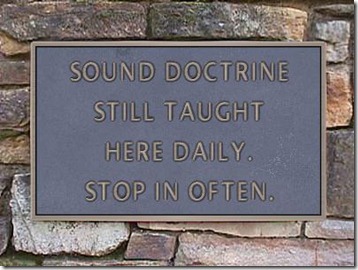
We are studying doctrine in our Junior High Girl’s Sunday School class.  I’ve written on it several times in the past – here are a few to review at your leisure:  Doctrine, Sound Doctrine, Sound Doctrine (no there’s not an echo, same subject, different time) and Doctrinal Matters.  There are more, but no one wants to hit them all.

As homework, we’ve asked the girls to write down their creed, the summary of their particular set of beliefs representing their faith. This is the fourth week, and none have been turned in.

Yes, they are busy in junior high school – much busier for those in for their first year.  However, I want them to build an understanding not only of what they believe, but why they believe it.

It is fairly simple for young people to memorize what is given to them, repeat it back to their teachers and not understand the basics underlying what they are saying.  We teach children that way for years. They learn to accept authority. One day they will find they can think for themselves yet not understand that all that glitters is not gold.

My goal is for these young ladies to question what I teach them.  To seek the answers beyond lessons spoke and find whether what I say has basis in God’s word.

There are very good orators out there whose messages sound very good, yet not doctrinally sound.  There are scholars who have questioned scriptures and found reason to deny them. I cannot question their reasoning nor their motive, but I pray I can instill a desire for these young ladies to seek answers through God’s word and prayer, as exampled in the suggested memory verse:

Study to shew thyself approved unto God, a workman that needeth not to be ashamed, rightly dividing the word of truth. (2 Timothy 2:15 KJV)

The King James Version has 53 references of ‘scripture’ or ‘scriptures’. Except for one in Daniel, they are in the New Testament and refer to the Tanakh, or what we call the Old Testament.  As part of our doctrine, we need to know why the New Testament authors referred to scriptures and we need to know why they thought prophecies were fulfilled.  We need to rightly divide the word of truth.  We need to know whether these things are so.

My favorite preachers give the gospel message – Jesus, Christ, was given by God to provide salvation through His mercy and grace for all mankind – and explain the consequences of denying His gift.  For me, there is but one testament, from Eden through today, that God is open to and waiting for each one to make the decision to follow His instructions.  A wise man once told anyone who would read and heed:

Let us hear the conclusion of the whole matter: Fear God, and keep his commandments: for this is the whole duty of man. (Ecclesiastes 12:13 KJV)

Centuries later another affirmed:

For this is the love of God, that we keep his commandments: and his commandments are not grievous. (1 John 5:3 KJV)

Wednesday, October 5, 2011

That’s Him

WhiteHorse
Some time ago I wrote that He left it all.  He did not bring a robe, not a crown, not ten thousand bowing down, not a piece of jasper wall – He left it all.

But, that’s not the rest of the story.  The separation from other religions is resurrection – and the time He spent with his disciples after the resurrection.  That is what makes Christians different.

Yet, that’s still not the rest of the story, either. Those ten thousand bowing down were but a handful.

And I beheld, and I heard the voice of many angels round about the throne and the beasts and the elders: and the number of them was ten thousand times ten thousand, and thousands of thousands; Saying with a loud voice, Worthy is the Lamb that was slain to receive power, and riches, and wisdom, and strength, and honour, and glory, and blessing. (Revelation 5:11-12 KJV)

That’s Him.

And I saw heaven opened, and behold a white horse; and he that sat upon him was called Faithful and True, and in righteousness he doth judge and make war. His eyes were as a flame of fire, and on his head were many crowns; and he had a name written, that no man knew, but he himself. (Revelation 19:11-12 KJV)

That’s Him.

And he hath on his vesture and on his thigh a name written, KING OF KINGS, AND LORD OF LORDS. (Revelation 19:16 KJV)

Oh, yes, that’s Him!

My Lord spent time on a cross and His earthly body died.  He did not. He lives, even as He told us Himself:

For he is not a God of the dead, but of the living: for all live unto him. (Luke 20:38 KJV)

The Lord, our Lord, is one – and He lives. Of great importance to each of us is whether or not our names are included the Lamb’s Book of Life.  The Bible tells us so.

Tuesday, October 4, 2011

Where Did You Learn About Religion?

temp
Every once in a while I wonder where people get their ideas about Christianity.  Often, online, I read where people write very derogatory things about Christians as a whole.  Some are personal experiences, some based on their view of historic events. How is religion viewed?

Muslims throw up the thousand-year-old crusades from western Europe as though it happened yesterday.  Christians have 9/11, which relatively speaking was yesterday.  Atheists look at both and see only animosity in them and other religions.

I read this on another website -- a comment left by a reader on a Christian blog about love:
"I don't need to read you, because if you love your God you have to love to everybody,"
I’m not sure what was meant by the sentence, but the author certainly had gained some knowledge of, and made a decision about, a Christian’s God. I wonder where that knowledge was gained, and I wonder about my reader’s.  Some state they have read God’s word, others state it has no value for them.  What I do here every day depends on how I view what I read of His word.

I believe reading the Bible will teach us what He has in mind for mankind.  While I use and appreciate study guides and lessons, I believe reading His word in prayer provides His plans for our lives.

I first learned about the Bible from my grandmother.  My Mom and Dad were without a church home for a while, but by the time I was eleven, lessons began in earnest.  I also learned about other beliefs.  It was a part of the lessons in our congregation – it’s hard to know what one believes without understanding why it is different from others.

So I learned about other Christian denominations.  I also learned about the differences among Jews today, not just the Sadducees and Pharisees of the New Testament.  I found Islam divided, too, beyond the Shi’ite and Sunni majorities. I’ve had a copy of the Book of Mormon, and while in Taiwan had the opportunity to read Buddha’s teachings.  I’m uncertain about the polytheism of Hindu deities, though I’ve discussed some specifically with co-workers.

My Muslim co-worker told me everyone is born a Muslim, but many are led astray to wrong religions, by society, by their parents or others. So far, that’s the only religion I’m aware of that is all inclusive – for a short time.  Also, I have yet to run across a religion that accepts everyone as they are, with no change in spiritual growth.

So, my question is – where did you learn about religion?  Did you trust that source/sources as much as I trust my path?

Study to shew thyself approved unto God, a workman that needeth not to be ashamed, rightly dividing the word of truth. (2 Timothy 2:15 KJV)

That was written by a man who sought to kill Christ’s followers before they were called Christian. God’s ability to change lives is greatly evidenced in Paul’s. Those who come to Him are changed, forever.

Monday, October 3, 2011

Is It Really Funny?

Laughter
A recent FB post caught my eye – and I wonder how funny these really are:
  • Funny how we call God our Father and Jesus our brother, but find it hard to introduce them to our family.
  • Funny how long it takes to serve God for an hour, but how quickly a team plays 60 minutes of basketball.
  • Funny how hard it is to read a chapter in the Bible, but how easy it is to read 100 pages of a best selling novel.
  • Funny how everyone wants to go to heaven provided they do not have to believe, or to think, or to say, or do anything.
  • Funny how so many churchgoers sing "Standing on the Promises" but all they do is sit on the premises.
  • Funny how people want God to answer their prayers, but refuse to listen to His counsel.
  • Funny how people think they are going to Heaven, but don't think there is a Hell.
Let’s take a short survey and find out if any of the above appears to be ‘funny’ in relation to our lives.
Do we speak of the time we spend with our Father in prayer?

After this manner therefore pray ye: Our Father which art in heaven, Hallowed be thy name. (Matthew 6:9 KJV)

Or do we just expect they’ll see us in church.  Oh, do we go to church?

Not forsaking the assembling of ourselves together, (Hebrews 10:25a KJV)

Do we find Bible verses hard to take, and the pastor one who steps on toes? Well, Peter thought Paul’s were hard, too:

And account that the longsuffering of our Lord is salvation; even as our beloved brother Paul also according to the wisdom given unto him hath written unto you; As also in all his epistles, speaking in them of these things; in which are some things hard to be understood, which they that are unlearned and unstable wrest, as they do also the other scriptures, unto their own destruction. (2 Peter 3:15-16 KJV)

As for that heaven/hell bit – Jesus spoke of its existence, and of some headed there:

Ye serpents, ye generation of vipers, how can ye escape the damnation of hell? (Matthew 23:33 KJV)

Thanks be to God that He also gave us the answer to that very question:

That whosoever believeth in him should not perish, but have eternal life. (John 3:15 KJV)

Revelation 22 describes the Tree of Life, beside the River of Life.  Take time to make your arrangements to picnic with me there during eternity.

Sunday, October 2, 2011

What Would We

Wheelchair
For we know that the law is spiritual: but I am carnal, sold under sin. For that which I do I allow not: for what I would, that do I not; but what I hate, that do I. If then I do that which I would not, I consent unto the law that it is good. (Romans 7:14-16 KJV)

Part of that verse is almost like a tongue-twister, but the gist of the matter is we know what we should be doing, and want to do, but don’t. By knowing that we should, we understand that the law is good for us – but we continue to break it.

Have you ever had a speeding ticket?  We know the speed limits are set for safety factors.  Our vehicles can go much faster than the set limits, just as there are so many things we can physically do beyond limits set for us.  Break the speed limit without an officer nearby and the worst result is nagging from a ‘back-seat’ driver (or front seat in some cases.)

One person said that speeding tickets are the tax we pay for driving fast, disregarding any built in safety factor for those in his car, and for other drivers on the road.

Going into the doctor last week, traffic was moving close to the speed limit – the right lane right at it, the left maybe five or so miles ahead of it – when a pickup to my right lost the retread on his tire.  Large pieces of rubber flew through both lanes, hitting the vehicles around us. Fortunately he maintained control, as did the others, and the slow down reminded us why speed limit and traffic pattern laws exist.

That, however, was the secondary lesson that came to mind from this morning’s verse.  My original thought was Beloved Husband, who is just now getting up.

BH wants to go to church every Sunday morning, evening and on Wednesdays.  He wants to go with me to my doctor appointments, and when I go to the grocery store.  The effects of Myasthenia Gravis is not allowing him to do so in all cases.  It is not a sinful nature that causes him to miss, but the flesh we occupy is weak, causing him to agree with Paul:  for what I would, that do I not.

The choice is no longer his, as it literally becomes difficult for him to hold his head up.  Muscles cease to respond. Exercise harms instead of helping. Yet, the desire to fellowship with those who love the Lord remains strong.  The desire to worship together, praise and give thanks in God’s house is just as strong.

As wrote the David so many centuries ago, so it is for his namesake today, even when he cannot go:

I was glad when they said unto me, Let us go into the house of the LORD. (Psalms 122:1 KJV)

I will know in an hour if he will be physically able to do so.  Did you?

Saturday, October 1, 2011

A Political Question


Want to have fraternity brothers over to watch your school’s football games for the season?  Want to invite your Red Cross blood drive volunteers over for a dinner meeting, with follow up visits?  Holding political fund-raisers at your home to help your favorite candidate?  Would you enjoy a barbecue with your Sunday School class monthly?

According to the Capistrano Dispatch, don’t try such law-breaking activities in San Juan Capistrano in California.  You will have ‘…violated section 9-3.301 of the Capistrano Municipal Code, which prohibits “religious, fraternal or non-profit” organizations in residential neighborhoods without a conditional-use permit.’  You might be able to do it once without someone complaining, but not on a regular basis according to the fines paid by the Fromm family.

This is not the same issue that faced David and Mary Jones in Bonita, California (click here for Channel 10’s report) back in 2009 where the initial complaint originated in parking disputes.  The Fromm’s have enough land to take care of attendee’s vehicles, which seems to be a question in Gilbert, Arizona, where the Oasis of Truth church cannot hold any religious meetings in any home in their town:
The town contends that, under its zoning code, churches within its borders cannot have any home meetings of any size, including Bible studies, three-person church leadership meetings, and potluck dinners. This ban is defended based upon traffic, parking, and building safety concerns. However, nothing in its zoning code prevents weekly Cub Scouts meetings, Monday Night Football parties with numerous attendees, or large business parties from being held on a regular basis in private homes. In fact, the zoning code explicitly allows some day cares to operate from homes.
Notably, the church only met for a few hours a week in members’ homes, and would rotate to different homes weekly. Further, the church was quite small, consisting of just seven adult members, including three married couples, and their four children.
The constitution addresses this specifically, “Congress shall make no law respecting an establishment of religion, or prohibiting the free exercise thereof;” which means any government entity within the United States cannot impose any religion, nor can it prohibit its citizens from their own. The depth of government entities extended from Congress through the 14th Amendment to include the states – not just for slavery, and including religion.

Where’s the biblical application?  For me it’s:

Not forsaking the assembling of ourselves together, as the manner of some is; but exhorting one another: and so much the more, as ye see the day approaching. (Hebrews 10:25 KJV)

We do that in fellowship on Thursday nights in a friend’s home – we pray before our meal, and often share specific prayer requests.  This could be construed as a religious organization in a residential home, even though most of the evening consists of domino games.

Why – with no one parked on the street, no music, no interference with the neighborhood – why would city, county, state or federal governments be concerned with this meeting?  In honesty, why would any neighbor?

The ability for Americans to assemble is protected, whether that assemblage is on Wall Street for protesting, or in my home for praying, and I rely on the confidence that this will not change in my country.

That’s my view – shared with but not imposed on others.