Tuesday, November 1, 2011

Change, Inside and Out

Change

If there was any wonder in your mind about a man’s ability to change his life for good, check out Bryan Widner’s story on MSNBC.

But we all, with open face beholding as in a glass the glory of the Lord, are changed into the same image from glory to glory, even as by the Spirit of the Lord.  (2 Corinthians 3:18 KJV)

May we be able to exhibit courage to change, shame enough to apologize and strength to continue.

Monday, October 31, 2011

Cox’s Army

CoxArmy
There were times when we had company and multiple dishes of food were ready for the table, my mother would say that we had enough food to feed Cox’s Army. I had a vague idea that the army wasn’t military and the name was created early in the twentieth century, but until I did a bit of research, I had no idea who Cox was and why he had an army.

Protests are not new to America, though few have been as successful as the civil rights movement.  Some, such as the Haymarket in Chicago, which “deeply polarized attitudes separating business and working class people in late 19th-century Chicago” turned violent.

This research was precipitated not only by the ‘Occupy’ groups making headlines, but an article about misery displayed in an index. Why do we focus on these miseries?

That question made me think of being content – sometimes it’s not good:

And Joshua said, Alas, O Lord GOD, wherefore hast thou at all brought this people over Jordan, to deliver us into the hand of the Amorites, to destroy us? would to God we had been content, and dwelt on the other side Jordan! (Joshua 7:7 KJV)

The Israelites were not to be content on the other side of Jordan, but were supposed to follow God’s instructions.  They had not done so. God told Joshua why they had failed:

Up, sanctify the people, and say, Sanctify yourselves against to morrow: for thus saith the LORD God of Israel, There is an accursed thing in the midst of thee, O Israel: thou canst not stand before thine enemies, until ye take away the accursed thing from among you. (Joshua 7:13 KJV)

For Paul, who was following God’s will for his life, being content came naturally:

Not that I speak in respect of want: for I have learned, in whatsoever state I am, therewith to be content. (Philippians 4:11 KJV)

That certainly did not mean accepting things as they were, for he was among those listed in Acts 17 who were turning the world upside down. But he did it in words of truth, not impeding the work of those around him.  He did it in prison, not escaping, but using his bonds as an example to others.

He did it in letters, to churches and to individuals, exhorting them to follow Christ’s example through good and bad:

I know both how to be abased, and I know how to abound: every where and in all things I am instructed both to be full and to be hungry, both to abound and to suffer need. (Philippians 4:12 KJV)

Paul was more concerned with a man’s soul and relationship to God than to physical situations.  He had been introduced to – and had followed – Christ’s instructions:

And he trembling and astonished said, Lord, what wilt thou have me to do? And the Lord said unto him, Arise, and go into the city, and it shall be told thee what thou must do. (Acts 9:6 KJV)

There he had learned what he continued to teach:

I can do all things through Christ which strengtheneth me. (Philippians 4:13 KJV)

Are we capable of turning the current world upside down without harming others? What changes should be employed, and why?

Sunday, October 30, 2011

The Lesson Continued


Moses wanted to be certain Israel remembered the covenant God made with Abraham, Isaac, Jacob and the entire nation. It bore repeating then and it bears repeating now.  It hasn’t changed in all this time.

This, however, is a generation beyond those who left Egypt.  Those original emigrants rebelled and were not allowed to set foot in the promised land. The next generation would accomplish their purpose.
Actions have consequences. Obedience does, too.  Moses reminded his listeners how God provided for them:

Thy raiment waxed not old upon thee, neither did thy foot swell, these forty years. (Deuteronomy 8:4 KJV)

Begin with Deutoronomy 8:12 where Moses begins with "Lest ..." and continues with all the things people desire for their own comfort - filled with food, living in a good house, wealth multiplied and hearts that forget God and what He has done - and those deeds are listed - then comes the sinfulness:

And thou say in thine heart, My power and the might of mine hand hath gotten me this wealth. (Deuteronomy 8:17 KJV)

That’s the start.  I’ve mentioned it over and over – some of my readers are probably tired of hearing that when we cease to follow God’s will, when we substitute “I will”, there are consequences.

Moses then reminds his listeners that power and wealth comes from God, with reasons.  And, that there are consequences for them (just as for us) if we forget:

And it shall be, if thou do at all forget the LORD thy God, and walk after other gods, and serve them, and worship them, I testify against you this day that ye shall surely perish. (Deuteronomy 8:19 KJV)

This tells me things haven’t changed since Moses’ time. The words of God bear repeating, reminding us again and again. Unlike some other reminders, I never tire of His.  I need the reminders.

It is so easy to forget.  Days are filled with activities that do not mention His name.  This generation has serious proponents for removing all mentioning of Him or His word from schools and any other public area, indicating those who mention Him are intolerant. I  beg to differ with them.

The most recent instance is the removal of a World War II memorial, more than fifty years after it’s erection by the Knights of Columbus, American citizens, American veterans, who wished to honor their fellow servicemen. A later generation forgot them and their reasons for the memorial were no longer relevant. As a consequence, the memorial must be removed.

Religions – not simply Christianity - have been a part of this land’s culture since its beginning. Tolerance allows citizens to practice their religion.  Intolerance requires its removal.

May we be allowed to remember.  Each and every one of us.

Saturday, October 29, 2011

A History Lesson

10commandmentsCI
Deuteronomy 5 begins with a history lesson for all the children of Israel. The Bible says:

And Moses called all Israel, and said unto them, Hear, O Israel, the statutes and judgments which I speak in your ears this day, that ye may learn them, and keep, and do them. (Deuteronomy 5:1 KJV)

This wasn’t a message simply for the tribal leaders, nor just for the priests.  This was a repetition of God’s words given on the mount as the people watched in fear a generation earlier in Exodus 20.  Those words bore repeating then, and they bear repeating today.

Moses was going through the statutes and judgments in order that God’s people would learn, keep and do them.  How do we measure up today on those three items?

What have we learned?  Not enough to pass lessons down more than a single generation, if we’re discussing economics. Sometimes the same if we’re discussing religion. Oh, the classes are there – every Sunday in most Christian churches, and often again on Wednesday nights, were attendance drops significantly.

What do we keep? The appearance today is that we keep what we want and toss what is inconvenient.  Paul saw it in that first century, and we see it today:

Who changed the truth of God into a lie, and worshipped and served the creature more than the Creator, who is blessed for ever. Amen. (Romans 1:25 KJV)

We look upon ecological disasters and call them an ‘inconvenient truth’ while tossing aside the Bible as simply inconvenient, denying it has truth. 

You think not? What part of the Bible is seen as no longer valid? The part we don’t “do”?

Moses was calling upon those who were freed by God to hear the statutes and judgments – and to do them.  Live by them.  He then repeated what we refer to today as the Ten Commandments.  You know, the ones that are illegal to display in portions of the United States, though they are revered by multiple religions. (Would their display constitute the establishment of Judaism?  Or Christianity?  That stretch of the imagination has resulted in lawsuit after lawsuit, hasn’t it? Or is it simply people of faith that must be squelched?)

A lot of people opt out on the very first of the statutes:

Thou shalt have none other gods before me. (Deuteronomy 5:7 KJV)

Once they opt out, they aren’t concerned about graven images, taking names in vain nor remembering special days.  They may, however, have some concerns about the next six, creating secular laws that protect families and personal property, never giving thought to how those laws fit right in to His.

All through the Bible there were men chosen to teach the same lessons over and over again that the people might learn them, and keep, and do them.  It’s available to us for the very same reasons. Will we get a passing grade?

Friday, October 28, 2011

The Voice

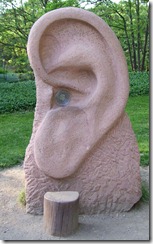
EAR-Luisenpark_Klanggarten_Ohr
And he said, Go forth, and stand upon the mount before the LORD. And, behold, the LORD passed by, and a great and strong wind rent the mountains, and brake in pieces the rocks before the LORD; but the LORD was not in the wind: and after the wind an earthquake; but the LORD was not in the earthquake: And after the earthquake a fire; but the LORD was not in the fire: and after the fire a still small voice. (1 Kings 19:11-12 KJV)

We’ve certainly had the great and strong winds up the east coast. The earthquake there, too. Fires were strong in Texas, New Mexico and many other states.  Some will say those were to get our attention, and I wouldn’t argue with that, but what I see are the natural forces set in motion at creation.  I would keep in mind that the Lord wasn’t in them in Elijah’s time, though He did pass by.

The remarkable thing was the still small voice of God.

Adam and Eve heard that voice, the call from someone who came to visit, regularly:

And they heard the voice of the LORD God walking in the garden in the cool of the day: and Adam and his wife hid themselves from the presence of the LORD God amongst the trees of the garden. (Genesis 3:8 KJV)

We haven’t changed much from those two in the Garden.  We think that we are alone, and we know that we’ve sinned against God.  We’ve forgotten that He does speak to us.  Some have become so inured to hidden from the damaging nature around us that we don’t listen.

Neither Elijah nor Adam had accomplished what God had set out for them to do. And they both had excuses.  Adam blamed God:

And the man said, The woman whom thou gavest to be with me, she gave me of the tree, and I did eat. (Genesis 3:12 KJV)

In a way, Elijah did, too:

And he said, I have been very jealous for the LORD God of hosts: for the children of Israel have forsaken thy covenant, thrown down thine altars, and slain thy prophets with the sword; and I, even I only, am left; and they seek my life, to take it away. (1 Kings 19:10 KJV)

Every thing there is true, except I, even I only, am left. He wasn’t, though the number of faithful was small.  Both Adam and Elijah felt alone because they were not close to God.

Are we close enough to hear?  Or do we need that huge ear?

Thursday, October 27, 2011

Revisited - Slices of Milk

This is a repeat from August, 2010.  There may be more of these repeats while we are traveling.
I read the Bible. Often. When I read about the Bible, or authors who refer to the Bible, they often pique my curiosity. Right now I’m re-reading Ben-Hur. I read it in High School, and thoroughly enjoyed the movie with Charlton Heston. It was a freebie, downloadable on the iPhone, and I could read it on a “pick up” basis any time, and lay it down without losing pace.

Until I came to the reference regarding David’s slices of milk, which I could not find. I looked and searched. I gave thanks for e-Sword, though it returned 48 milk possibilities, none of those verses referred to David or slices. So, I tried other versions – remembering when the book was written. Finally, found it!!

Again, I was grateful for e-Sword and it’s Strong’s!! Strong’s H2461 found in 1 Samuel 17:18 where the ten slices of cheese come from the Hebrew chalab, “milk (as the richness of kine) - + cheese” and I can see the ten slices of cheese made from the richness of milk, remembering the smoothness of the best I’ve tasted.

This is part of the joy of reading the Bible – the depth and richness of the words used. A surface reading gives history. Looking more deeply and we get the personalities, the characters, the richness of the stories told for generations. But there is a greater depth – reading with prayer and preparation, reading to receive – where the spiritual message becomes evident.

No, there is no secret message for me in David’s slices of cheese other than the understanding that God’s word holds more than surface reading. There are applications for daily life in every scripture I’ve ever read. I have found some, as Peter wrote in 2 Peter 3:16, hard to be understood, and not just in Paul’s writing.

I have not found why Isaiah wrote of a bed too short in 28:20. Perhaps someday I will know, but the verse does create a word picture that brings a smile. Was the bed long enough for a young, or short person, but the grown man could find neither comfort nor cover? There are times we long for that comfortable bed, sufficient cover and enough sleep to wake with vim, vigor and vitality. Is that the verse’s message for me? Perhaps, yet to be confirmed.

There are many such verses that pique our interest, raise our curiosity, leave us seeking more and more of what God’s word has to offer. I have never tired of reading. Never tired of hearing a minister share what God’s word means to him, what He has in store for us.

I pray that I’m tossing out seeds of curiosity – perhaps someone will disbelieve what I say and search the scripture to see if it is true. God’s word does not return void. He said so.

So shall my word be that goeth forth out of my mouth: it shall not return unto me void, but it shall accomplish that which I please, and it shall prosper in the thing whereto I sent it. (Isaiah 55:11 KJV)

Scriptures are God breathed. He said so.

All scripture is given by inspiration of God, and is profitable for doctrine, for reproof, for correction, for instruction in righteousness: (2 Timothy 3:16 KJV)

That “inspiration” word? Again, Strong’s for the Greek root: theopneustos, divinely breathed in.

Come, jump on in. Look deeply into God’s word and see what it holds for you.

Wednesday, October 26, 2011

Slipping and Sliding

Pratfall

When I said, My foot slippeth; thy mercy, O LORD, held me up. (Psalms 94:18 KJV)

We all slip – often on very solid grounding. It can happen when we’re not paying attention to where we are going. Keeping focused on our walk helps keep that from happening, still surprises arise.

Mankind wasn’t the first to fall. Jesus speaks of seeing Satan’s fall:

And he said unto them, I beheld Satan as lightning fall from heaven. (Luke 10:18 KJV)

Many equate that fall to one described in Isaiah:

How art thou fallen from heaven, O Lucifer, son of the morning! how art thou cut down to the ground, which didst weaken the nations! For thou hast said in thine heart, I will ascend into heaven, I will exalt my throne above the stars of God: I will sit also upon the mount of the congregation, in the sides of the north: I will ascend above the heights of the clouds; I will be like the most High. Yet thou shalt be brought down to hell, to the sides of the pit. They that see thee shall narrowly look upon thee, and consider thee, saying, Is this the man that made the earth to tremble, that did shake kingdoms; (Isaiah 14:12-16 KJV)

Men have done a very good job on their own, too. Even those who chose to follow Christ, to give their all for Him.  Peter is the first example that comes to mind.  One of the earliest disciples, absolutely the most outspoken and defensively active, he still denied Jesus, just as prophesied.  Instead of being left at the wayside as a dulled example of failure, he received the same mercy offered to us and a lifetime of service.

There are other great examples in the Bible of those who failed to live up to their abilities – and God’s calling – who receive His mercy.  There are also examples of those who failed and never returned for mercy.

The backslider in heart shall be filled with his own ways: (Proverbs 14:14 KJV)

Which brings me back to the “Thy will be done,” that Jesus so often prayed.  When we change from “I will” to “Thy will” our lives are changed, too.